The Musical Innertube - Volume 2, Number 205 - Jesse Wegman and our Lost Founder

Founding Father James Wilson. Wrote "all men are created equal" 6 years before Jefferson. Came up with the Electoral College for the Constitution. A Supreme Court Justice who helped design America's justice system. Jesse Wegman is here to tell us why no one remembers this Founding Father.
Here's one of the main reasons Jesse's book on James Wilson is so important. In The Lost Founder, Jesse writes:
What would America look like if we could see ourselves as Wilson
saw us? Take the recent debate over what ties this country together in
the first place.
Is it “a group of people with a shared history and a common future,” as Vice President J. D. Vance has said? Or is it, as Wilson and
other founders understood, a creed? A living, unexpiring promise of
freedom and self-determination that can be adopted by anyone who
believes in it, even a poor farmer’s son from the Scottish Lowlands.
Vance has argued that this creedal definition is “way overinclusive,”
as it would open America’s doors to all who agree with our foundational values.
Abraham Lincoln, on the other hand, understood things in a
more Wilsonian spirit. In 1858, Lincoln described the essential lines
of the Declaration of Independence, the ones Wilson himself helped
inspire—“We hold these truths to be self-evident, that all men are
created equal”—as an “electric cord” that “links the hearts of patriotic and liberty-loving men together.” Lincoln understood how the
“moral sentiment” of those words has the power to unite people from
disparate parts of the earth, giving them “a right to claim it as though
they were blood of the blood, and flesh of the flesh of the men who
wrote that Declaration, and so they are.” Lincoln was expressing the
essence of Wilson’s worldview, whether he knew it or not.
Today, 250 years after America’s birth, Wilson continues to challenge us to live up to his vision, and to use its light to chart our way
forward. Were he alive now, he would look at a Senate increasingly
skewed in favor of smaller states and an Electoral College that has
turned popular-vote losers into presidents twice already in this century and say, I told you so. He would be grimly amused that the greatest obstacles to majority rule in the twenty-first century reside in the
Constitution itself.
This is not to say Wilson was infallible. It is difficult, for example,
to look favorably at his insistence on a powerful chief executive in
our moment, when President Trump has arrogated to himself near-
monarchical powers. (Previous presidents have sought to expand
their power in their own ways, of course, but none with a comparable
speed or tenacity.) Many of Wilson’s contemporaries foresaw this risk
and were rightly desperate to avoid it, but Wilson’s expansive vision
for Article II of the Constitution won out. He might respond that the
other branches were designed to serve as reliable checks on executive
overreach: through judicial review in the courts and the Necessary
and Proper Clause in Congress.
That is cold comfort in 2026, when the Supreme Court has green
lighted most of this overreach and Congress has ceded many of
its core constitutional powers to the executive (at least when both
branches are controlled by the same party).
In the big picture, however, resurrecting James Wilson reminds
us how the insistence on democracy in America was there from the
start, and from one of the nation’s foremost architects. At the same
time, his story serves as a warning that democracy has always been an
elusive thing. Now our democracy’s future—the future Wilson saw
more clearly than anyone else—is in real doubt. The question we
face today is whether we can reimagine it. Whether we can reimagine
a Constitution, and a country, shaped by his vision. Wilson cannot
answer that question, but we have no choice. As he said in his speech
in the State House Yard, “The seeds of reformation are sown in the
work itself."
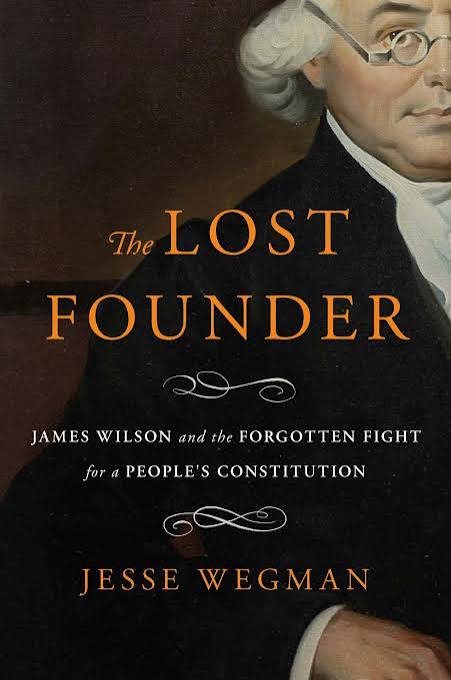
Want your own personal copy of The Lost Founder? No problem! Get it here or here!
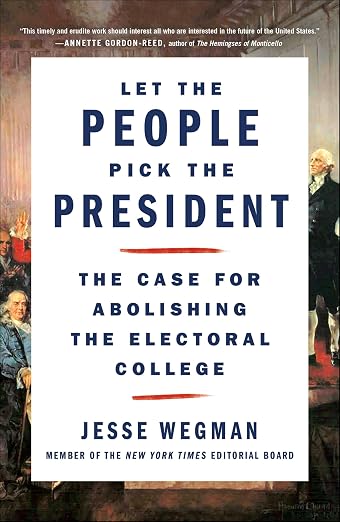
Want to start a Jesse Wegman wing on your bookshelf or library? Also no problem! Get his first book here!
There's more Jesse on his website: jessewegman.com

Jesse Wegman is a senior fellow in the Office of the President at the Brennan Center. He works with the Kohlberg Center on the U.S. Supreme Court, the Future of the Constitution Advisory Committee, and Brennan Center Ventures on electoral policy and democracy reform.
From 2013 through 2025, Wegman was a member of the New York Times editorial board, where he wrote more than 1,000 editorials and signed pieces on law and politics, the Supreme Court, democracy, and the rule of law. His work was part of a Times package that won the Pulitzer Prize for Public Service in 2018. Before the Times, Wegman was a senior editor at Newsweek and The Daily Beast, a legal editor at Reuters, and a reporter and producer for National Public Radio.
Wegman is the author of Let the People Pick the President: The Case for Abolishing the Electoral College (St. Martin’s Press, 2020) and the forthcoming book The Lost Founder: James Wilson and the Forgotten Fight for a People’s Constitution (Celadon, June 2026), the first full-length biography in more than 70 years of the most democratic of all the American founders. Wegman has been a regular guest on MSNBC, CNN, and many other national and local TV and radio programs to discuss the Electoral College and democracy reform more broadly.
Wegman received his undergraduate degree from Wesleyan University and a law degree from NYU School of Law. He clerked for Judge Gabriel W. Gorenstein at the U.S. District Court for the Southern District of New York.


